About Kiko

We are building the calmest software in HR.

The tools that run employment are usually the ones people dread opening. We are rebuilding that stack around a single employee record, so the work gets finished instead of retyped into the next system along.

2024
Founded

Two payroll cycles in, the first customer went live

9
Connected modules

Recruitment through exits, reading one record

38
People building it

Engineering, payroll compliance, design, support

Bengaluru
Where we are

One office, and a team that works from six cities

Our story

It started with a month-end close that took five days

In early 2024 we sat with four HR teams through a payroll close, not to sell anything, just to watch. Every team was competent. Every team was late. And every delay traced back to the same thing: a handoff between two systems that did not know about each other, bridged by a person with a spreadsheet and a deadline.

An offer accepted in the ATS became a joiner typed into the HRIS. A biometric export became a leave sheet reconciled by hand. A review rating became a number somebody remembered to carry into the revision letter. None of it was hard work. All of it was work that should never have existed.

So we built the employee record first, and the modules afterwards. Recruitment, onboarding, attendance, payroll, performance, engagement and exits all read and write the same record, which is why an accepted offer can become a joined employee without a single field being retyped, and why a locked attendance period can feed a payroll run without anybody exporting anything.

The measure we hold ourselves to has not changed since that first close: how much of the month-end still happens in a spreadsheet. The answer should be none of it.

Illustration of a team at work beneath the words a happier workplace for brighter tomorrows

The line that went up on the wall in the first week, and has not come down since.
What we set out to delete

Not the software. The work between the software. Every line on the left is a handoff we watched a real team perform by hand, every month, forever.

The patchwork

Four tools, and a person holding them together

  • An ATS that hands over a PDF, then someone retypes the joiner
  • A biometric export reconciled by hand against a leave sheet
  • Payroll in a spreadsheet, with the previous month copied across
  • Reviews in a form tool that nobody links back to a revision
  • Four exports, four formats, and a finance team stitching them
  • An exit that leaves access live because the checklist sits in email

One record

The same month, with the handoffs removed

  • An accepted offer becomes a joined employee, with nothing retyped
  • Punches, regularisations and leave land in one attendance register
  • A locked period feeds the run, and exceptions surface before approval
  • Ratings flow straight into the next revision and the letter
  • One workspace, one export, and reports that already agree
  • An exit revokes access, settles dues and files the record in one flow

Six things we decided early and have not renegotiated

Most of these cost us a feature at some point. All of them are why a customer can close a month without checking our work.

One record, or it does not count

A module that needs its own copy of an employee is not a module, it is another system to reconcile. Everything reads and writes the same record.

Correct before clever

PF, ESI, professional tax and TDS are not features to differentiate on. They are arithmetic that has to be right on every plan, every month, in every state.

An approved run is immutable

Corrections flow through the next cycle as arrears. Nobody quietly edits a month that has already been paid, and the audit trail stays worth reading.

Boring where it counts

Payroll windows are treated as change freezes. The most valuable thing we can do in the last week of a month is ship nothing at all.

Built for the person, not just the admin

The employee portal is not an afterthought screen. If someone cannot find their leave balance in one tap, that is our bug, not their training gap.

Say what is not built yet

There is no public API today, and the site says so. A roadmap dressed up as a feature list costs a customer a quarter, and costs us the relationship.

The same record, from both sides of the desk

Admins get the whole company. Employees get exactly their own row, and nothing belonging to anybody else. Neither view is a report generated out of the other.

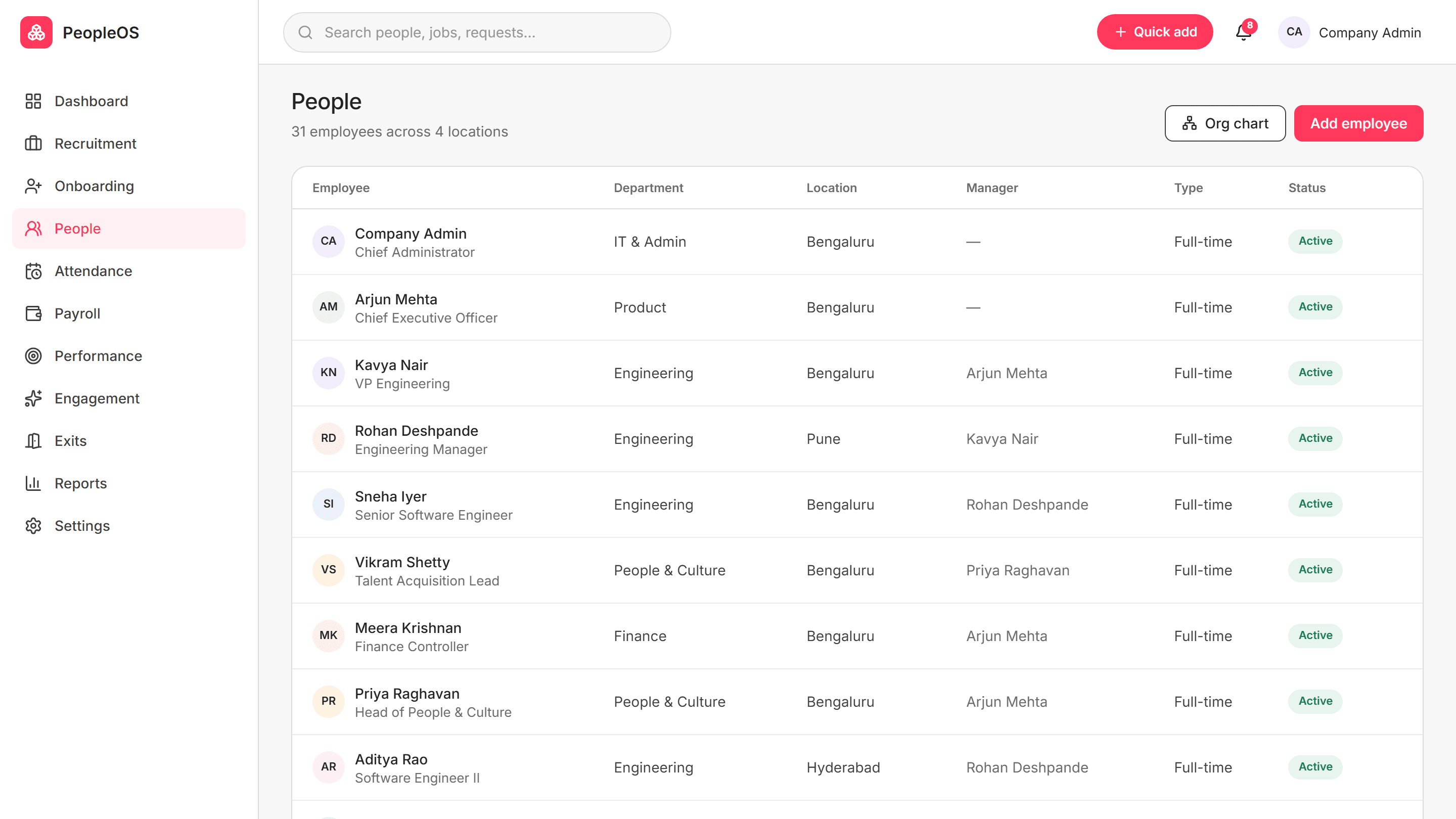
Kiko company workspace listing employees with department, location and manager
For HR and admin

The whole company in one workspace

Headcount, departments, managers and locations on one register. Every module downstream reads this, so an org change lands once.

Open the workspace
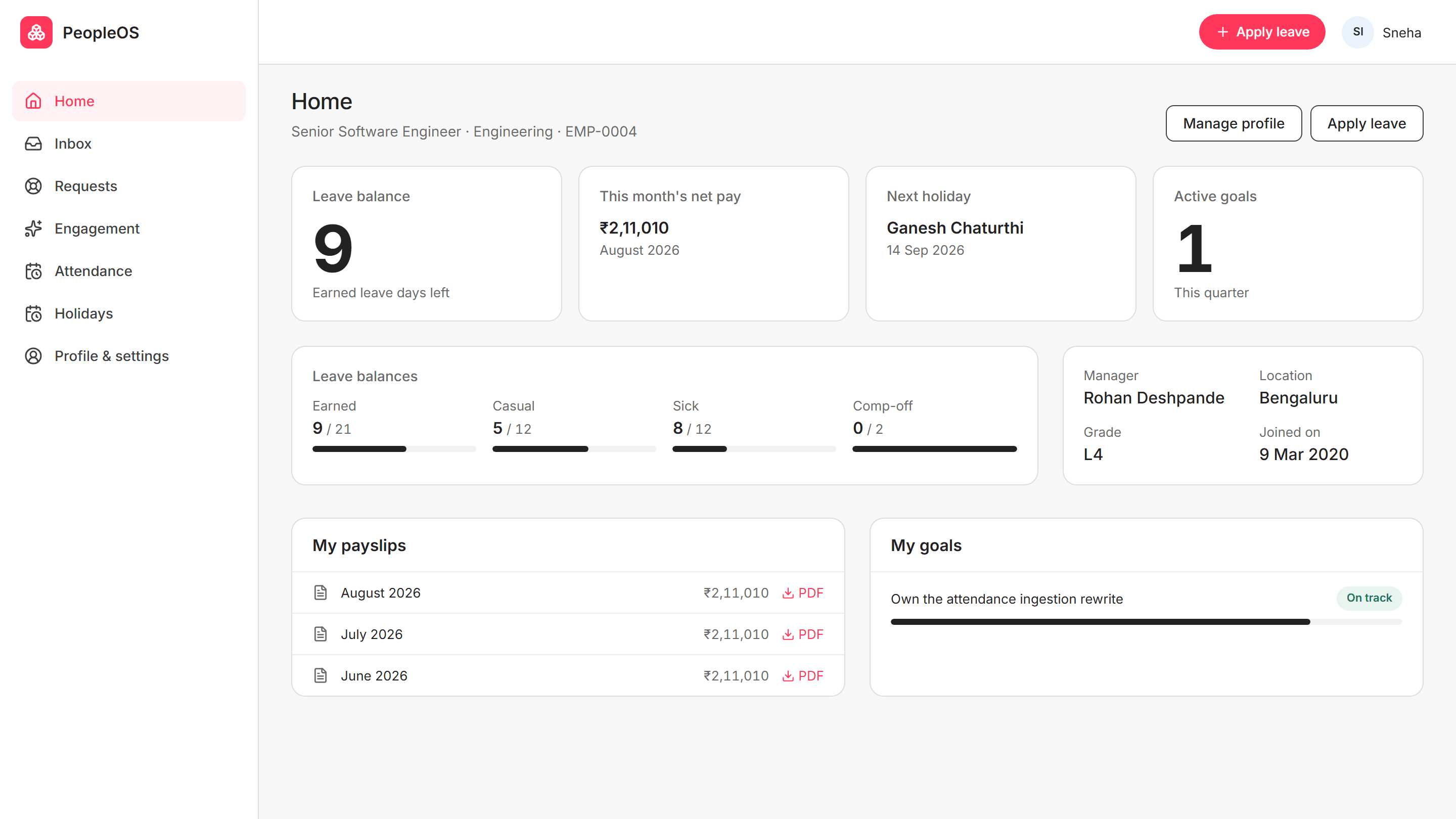
Kiko employee portal home showing leave balance, payslips and goals
For every employee

Their own record, self-serve

Leave balance, payslips, goals and company updates in one place, scoped to them. No ticket to HR for a number the system already knows.

See the employee portal

How the platform got here

Nothing here shipped because it demoed well. Each step existed to let a customer switch one more system off.

  1. Early 2024

    The spreadsheet audit

    We sat with four HR teams through a month-end close and counted the handoffs. Every one was a person being retyped into another tool.

  2. Mid 2024

    One employee record

    Rather than another point tool, we built the record first and the modules around it. Recruitment and attendance had to prove it worked.

  3. Late 2024

    First parallel payroll

    A 140 person run, computed alongside the incumbent provider and compared line by line. Three cycles before the variance report came back empty.

  4. 2025

    Statutory across states

    Professional tax by work location, PF and ESI thresholds, TDS projections. The point where a customer could switch the second system off.

  5. Now

    Hire to retire, closed

    Performance, engagement and exits shipped, so the record covers the whole arc rather than the parts that were easiest to build.

The people behind it

Payroll people, ledger engineers and designers, in roughly that order of stubbornness. Everyone on this list has sat through somebody else’s month-end close.

Ananya Krishnan

Co-founder and CEO

Ran people operations through three payroll migrations before deciding the tooling was the problem.

Devan Rao

Co-founder and CTO

Built ledger and settlement systems in fintech, and brought the immutability rules with him.

Farah Sheikh

Head of Payroll Compliance

Fifteen years of statutory filings across eight states. Reviews every slab change before it ships.

Nikhil Bose

Head of Design

Believes an HR screen should be the calmest tab open on the desktop, not the heaviest.

Reema Thomas

Head of Customer Success

Runs every rollout personally, from migration through to the first clean close.

Your name here

We hire slowly, and mostly into engineering, payroll compliance and customer success. Tell us which of these problems you want to own.

careers@kiko.co

How we work

We run the company on the product

Our own leave, payroll, reviews and onboarding sit in Kiko. When a screen is annoying at month-end, we are the first people it annoys.

Freeze weeks are real weeks

Nobody ships into a customer's payroll window, so nobody spends the last week of a month firefighting.

Office optional, overlap required

Bengaluru if you want a desk, anywhere if you do not. Four hours of overlap is the only rule.

Everyone learns the statute

Designers and engineers sit in the compliance review. You cannot design a payslip you do not understand.

Leave you can actually take

Six months primary and twelve weeks secondary parental leave, with the cover planned before the announcement.

Indiranagar, Bengaluru, and six other cities

38 people, one payroll run

The questions we get asked about us

Who we are built for, who is running it today, and what happens to your data if it does not work out. If yours is not here, bring it to the demo.

Ask us directly
  • Is Kiko built for India specifically?

    The statutory engine is, yes. PF, ESI, professional tax by state and TDS projections are first class rather than a localisation pack. The rest of the platform, from recruitment through to exits, is not India specific, and multi-country payroll is a roadmap item rather than something shipped.

  • Who is actually running it today?

    Companies between roughly 80 and 900 people, mostly product studios, retail chains and logistics operators, where attendance is messy enough that payroll inherits the mess. A single workspace is built to hold 50,000 employees, which is well past where our current customers sit.

  • Are you venture funded, and does it change the pricing?

    We are funded, and it does not. Plans are quoted around headcount and statutory footprint, contracts are annual, and there is no per-seat meter running while you evaluate.

  • What happens to our data if we leave?

    You export it. Every list view produces CSV or XLSX, employee records and historic payslips come out in full, and we do not hold a migration hostage. Statutory records you are legally required to retain stay retrievable through the notice period.

  • How do you handle security?

    Bank accounts, PAN and salary figures carry field-level encryption on top of encryption at rest, on every plan. Compensation visibility is granted explicitly per role, so a manager can approve leave and write a review without a salary figure appearing on screen.

  • Are you hiring?

    Usually, and slowly. Engineering, payroll compliance and customer success are the roles that come up most. Write to careers@kiko.co with what you have built and which of these problems you want to own.

Come and see whether we are right about any of this.

Thirty minutes, your actual month-end, and an honest answer about which parts of it Kiko removes today and which parts it does not.

No card, no rollout commitment, and we will say so if you are too small for us.

Illustration of two colleagues high-fiving
Illustration of two people climbing a rising arrow towards a star
Illustration of someone relaxing while a robot carries their paperwork
One record, hire to retire