
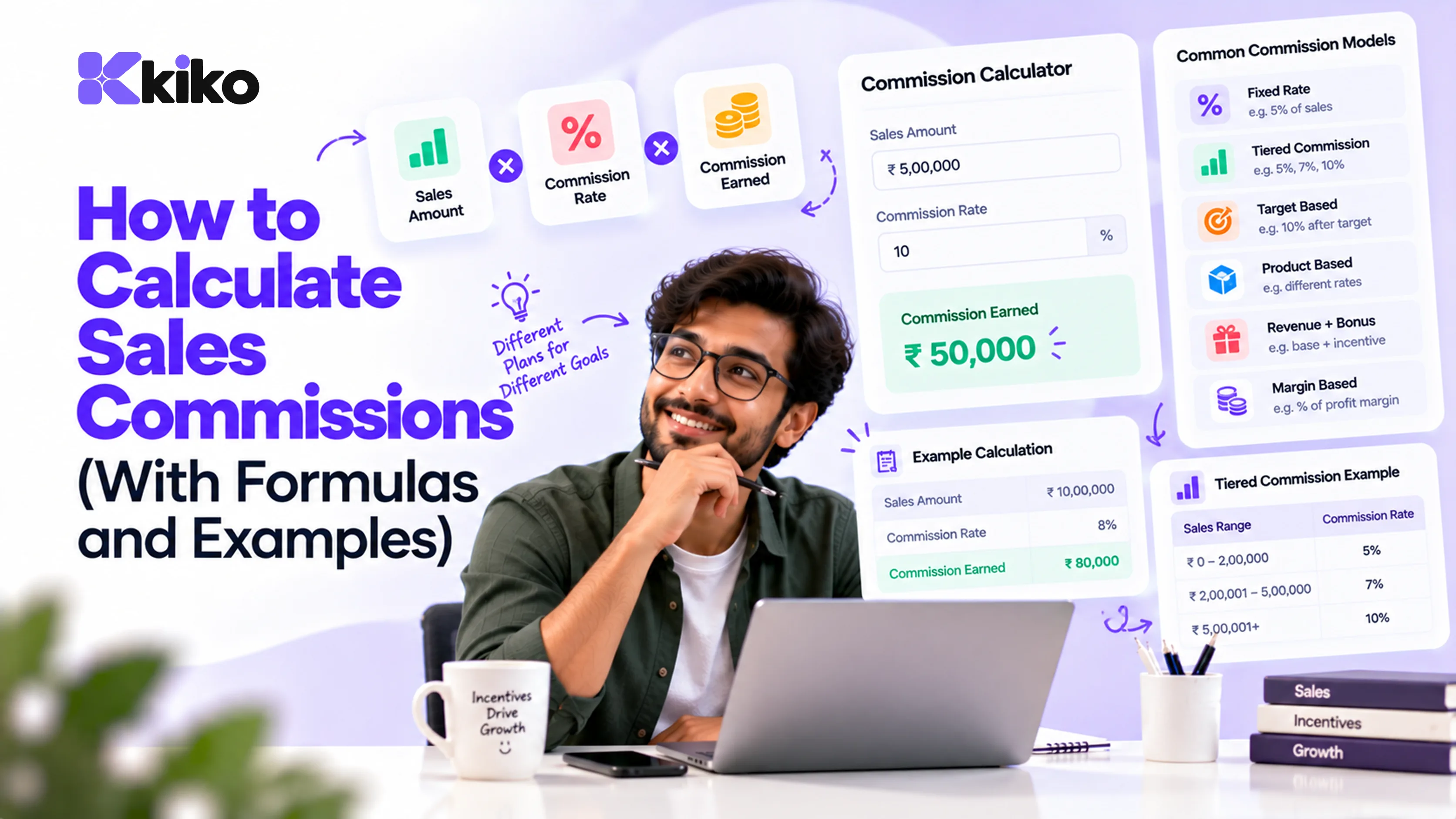
Sales commission is calculated as the sale amount multiplied by the commission rate. For example, a 10% rate on a ₹5,00,000 deal pays ₹50,000. Tiered plans pay higher rates once a rep passes set targets, and quota-based plans pay a percentage of target variable pay based on how much of the quota the rep achieved.
What is the basic sales commission formula?
Commission = sales amount × commission rate
A rep who closes ₹5,00,000 at a 10% rate earns ₹5,00,000 × 0.10 = ₹50,000. Every other structure in this guide is a variation on this formula: it changes what counts as the "sales amount" (revenue, margin, recurring revenue) or how the rate changes with performance.
Before you calculate anything, your commission plan should answer four questions in writing:
- What is credited: booked contract value, invoiced amount or cash collected? Before or after GST and discounts?
- When it is earned: on signature, on invoice, or on customer payment?
- Who gets credit: how are split deals and handoffs between reps handled?
- When it is paid: monthly, quarterly, or after a holding period?
Most commission disputes come from these definitions, not from the arithmetic.
What are the 7 common commission structures?
| Structure | Formula | Best for |
|---|---|---|
| 1. Straight (flat-rate) commission | Sales × rate | Agents, high-volume transactional sales |
| 2. Base salary + commission | Base + (sales × rate) | Most B2B sales roles |
| 3. Tiered commission | Rate rises as sales cross set bands | Rewarding over-performance |
| 4. Quota-based (target incentive) | Target variable pay × quota attainment % | Teams with clear quotas and OTE |
| 5. Gross margin commission | (Revenue − cost) × rate | Businesses where reps influence pricing and discounts |
| 6. Residual (recurring) commission | Recurring revenue collected × rate, each period | Subscriptions, AMCs, retainers |
| 7. Draw against commission | Pay the greater of draw or earned commission; recover shortfalls if recoverable | New reps ramping, long sales cycles |
How do you calculate each commission structure? Worked examples
1. Straight commission
The rep earns only commission, with no fixed salary. A rep selling ₹8,00,000 in a month at 8% earns ₹8,00,000 × 0.08 = ₹64,000. This is rare for salaried employees in India and more common for independent agents and channel partners.
2. Base salary + commission
Total pay = base salary + (sales × rate)
A rep with a ₹40,000 monthly base who closes ₹6,00,000 at 5% earns ₹40,000 + ₹30,000 = ₹70,000 for the month. The base gives stability; the commission keeps the focus on closing.
3. Tiered commission
Rates increase as the rep crosses set bands. Say the plan pays 5% on the first ₹10,00,000 each quarter, 8% on sales between ₹10,00,000 and ₹20,00,000, and 12% above ₹20,00,000. A rep who sells ₹25,00,000 in the quarter earns:
| Band | Sales in band | Rate | Commission |
|---|---|---|---|
| ₹0 – ₹10,00,000 | ₹10,00,000 | 5% | ₹50,000 |
| ₹10,00,000 – ₹20,00,000 | ₹10,00,000 | 8% | ₹80,000 |
| Above ₹20,00,000 | ₹5,00,000 | 12% | ₹60,000 |
| Total | ₹25,00,000 | ₹1,90,000 |
This is a marginal tier: each rate applies only to sales within its band, like income tax slabs. Some plans use retroactive tiers, where crossing a band raises the rate on all sales. Under a retroactive version, the same rep would earn 12% of ₹25,00,000 = ₹3,00,000. Retroactive tiers create a cliff, where one small deal can add lakhs to a payout, so state clearly which type you use.
4. Quota-based (target incentive)
Commission = target variable pay × quota attainment %
A rep has a quarterly quota of ₹30,00,000 and target variable pay of ₹1,50,000. Closing ₹24,00,000 means 80% attainment, so the payout is ₹1,50,000 × 0.80 = ₹1,20,000. Many plans add a threshold (for example, no payout below 50% attainment) so commission rewards real performance.
This structure also gives you the effective rate: ₹1,50,000 ÷ ₹30,00,000 = 5% of every rupee sold at target.
5. Gross margin commission
Commission = (revenue − cost of goods or delivery) × rate
A ₹10,00,000 order with ₹6,00,000 in cost leaves ₹4,00,000 of margin. At 15% of margin, commission is ₹60,000. If the rep had given a ₹1,00,000 discount, margin and commission would both fall (to ₹3,00,000 and ₹45,000), which is exactly the behaviour this structure is meant to encourage.
6. Residual commission
Commission per period = recurring revenue collected × rate
A rep signs a customer paying ₹50,000 a month. At a 5% residual rate, the rep earns ₹2,500 every month the customer pays, often for a fixed period such as the first 12 months. Residuals reward keeping good customers, not just signing them.
7. Draw against commission
The rep receives a fixed draw (an advance) each month, and earned commission is set against it. With a ₹30,000 monthly draw:
- Earned commission of ₹45,000: the rep receives the draw plus ₹15,000 extra.
- Earned commission of ₹20,000: the rep still receives ₹30,000. Under a recoverable draw, the ₹10,000 shortfall is recovered from future earnings; under a non-recoverable draw, it is not.
What are accelerators, caps and clawbacks?
Accelerators pay a higher rate once a rep passes quota. Example: target variable pay is ₹1,50,000 at 100% of quota, and each percentage point above 100% pays at 1.5 times the normal rate. At 120% attainment the payout is ₹1,50,000 + (20% × 1.5 × ₹1,50,000) = ₹1,50,000 + ₹45,000 = ₹1,95,000.
Caps put a ceiling on commission, for example 200% of target variable pay. Caps protect the company from windfall deals but can make top reps hold deals back once they hit the ceiling. If you cap, set it high and handle exceptional deals case by case.
Clawbacks recover commission when a deal doesn't hold, for example if the customer cancels within 90 days or never pays. Write the trigger, the window and the recovery method into the signed plan. In India, deductions from wages are regulated, so check how you recover clawbacks with your legal or payroll adviser.
| Term | What it does | Typical trigger |
|---|---|---|
| Accelerator | Raises the rate above quota | Attainment above 100% |
| Decelerator / threshold | Lowers or removes payout below a floor | Attainment below a set % |
| Cap | Limits maximum payout | Payout reaches set ceiling |
| Clawback | Recovers commission already paid | Cancellation, refund or non-payment |
Why do commissions break when sales and payroll live in separate tools?
The formulas are simple. The process around them usually isn't. In a typical setup, deals live in the CRM, payments in accounting, and salaries in the payroll tool. Each month someone exports closed deals, checks which were paid, applies the plan rules in a spreadsheet and sends totals to payroll.
Every handoff is a chance for error:
- A deal value changes in the CRM after the export.
- A split deal is credited twice, or not at all.
- A cancellation never reaches the commission sheet, so no clawback happens.
- Payroll receives a total but no breakdown, so reps can't check their numbers.
We covered the broader problem in our post on tool sprawl and sales-HR alignment. The fix is to calculate commission from the same records that hold deals and pay. In Kiko, deals and quotas in Kiko Sales CRM sit on the same data layer as payroll runs in Kiko HRMS, and a closed-won automation can kick off the next steps when a deal is won, so fewer numbers are copied by hand. If you're setting quotas for the year, our guide to sales forecasting methods shows how to tie them to a realistic revenue plan.
Frequently asked questions
What is a typical sales commission rate?
Rates vary widely by industry, deal size, margin and how much of a rep's pay is fixed. A practical way to set yours is to work backwards: rate = target variable pay ÷ quota. A rep with ₹6,00,000 of annual target variable pay and a ₹1,20,00,000 quota implies a 5% rate.
Is commission paid on revenue or profit?
Most plans pay on revenue because it is simple and easy for reps to verify. Paying on gross margin makes sense when reps control pricing and discounts, because it discourages giving margin away to close a deal. Some companies use revenue-based commission with a reduced rate for heavily discounted deals.
How are commissions taxed in India?
Commission paid to employees is part of their salary, so it is taxed as salary income and the employer deducts TDS under section 192 of the Income-tax Act, 1961 when it is paid. The Income-tax Act, 2025 renumbers these provisions, and commission paid to non-employee agents follows different TDS rules. Confirm the treatment for your company with your accountant.
When should commissions be paid out?
Monthly or quarterly payouts are most common, usually in the payroll run after the period closes. Paying on customer payment rather than signature reduces clawbacks, and short gaps between closing and payout keep the plan motivating.
Connect closed deals to commission payouts
If commissions still run through exports and spreadsheets, start by putting deals, quotas and payroll on one set of records. Book a Kiko demo to see how closed-won deals, quotas and payroll runs connect in one platform.