
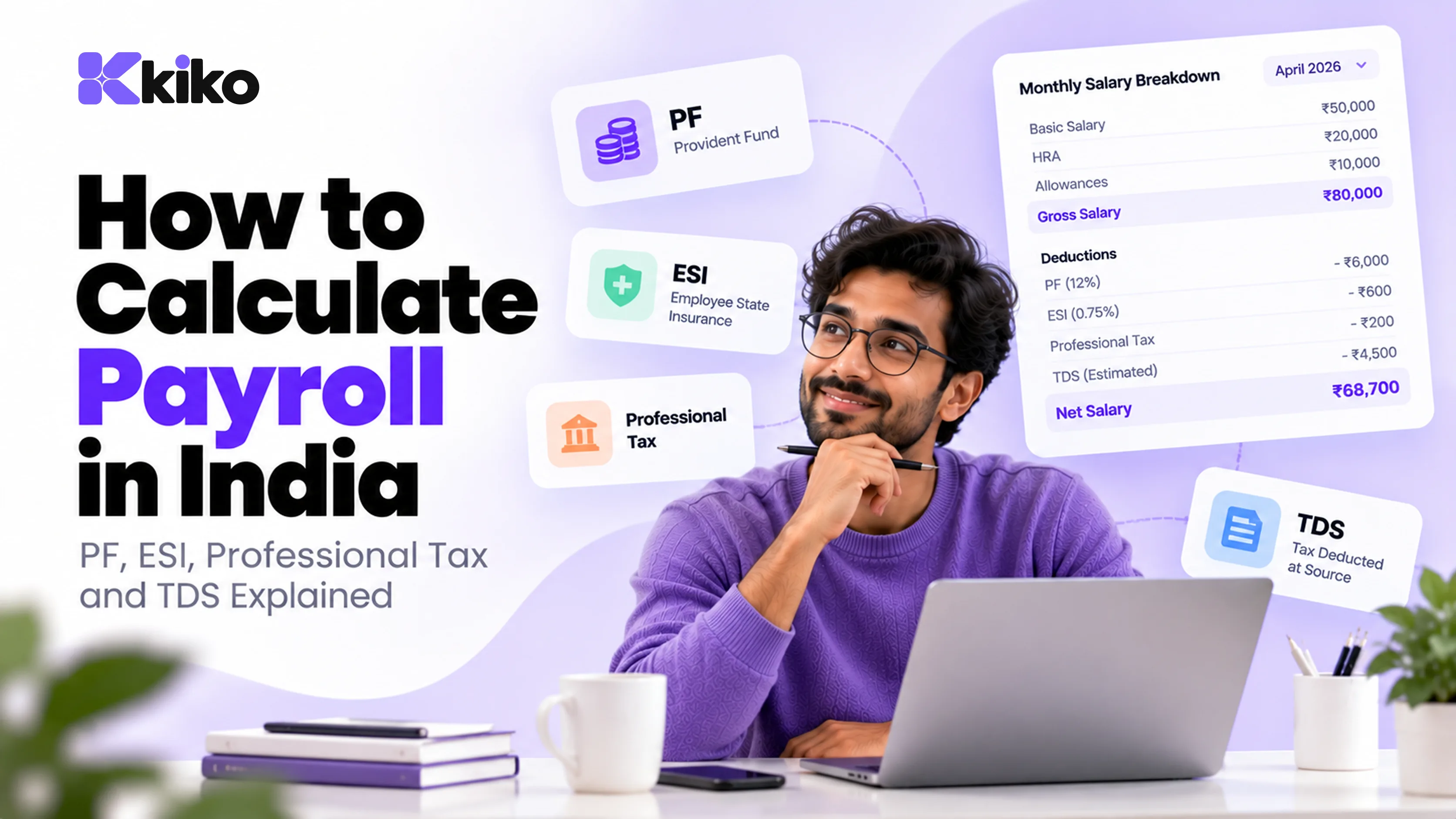
To calculate payroll in India, start from gross salary, then deduct the employee's Provident Fund (usually 12% of basic wages), ESI (0.75% of gross where wages are within the ESI limit), state professional tax, and TDS on salary under the employee's chosen tax regime. Employers also pay their own PF and ESI contributions on top.
What is the payroll formula in India?
Work out what the employee earned for the month, subtract statutory and other deductions, and pay the rest. The employer's own contributions sit on top of gross salary and form part of cost to company (CTC).
| Formula | What goes into it |
|---|---|
| Gross earnings | Basic + DA + HRA + allowances + overtime or incentives − loss-of-pay deduction |
| Net pay | Gross earnings − employee PF − employee ESI − professional tax − TDS − other deductions (advances, loans) |
| Monthly cost to company | Gross earnings + employer PF (including EPS, EDLI and admin charges) + employer ESI + other benefits such as gratuity provision and insurance |
Important: the figures in this guide are for FY 2025-26 (April 2025 to March 2026). Statutory rates, wage ceilings and tax slabs change, and India's new labour codes change how "wages" are defined for PF and other contributions. Confirm current rules with EPFO, ESIC, your state's professional tax department or a payroll professional before you run payroll.
Step 1: How do you build the salary structure?
The salary structure decides every deduction that follows, because PF is calculated on basic wages, ESI on gross wages, and tax on taxable salary. A typical structure has four parts:
- Basic salary: the fixed core of pay. Many companies set it at 40% to 50% of gross. PF and gratuity are calculated on basic (plus DA, if you pay it).
- Dearness allowance (DA): common in government and some manufacturing roles, rare in private-sector office jobs. Where it exists, it counts with basic for PF.
- House rent allowance (HRA): often 40% of basic, or 50% in metro cities. Under the old tax regime, part of HRA can be exempt if the employee pays rent. Under the new regime, there is no HRA exemption.
- Special allowance and other allowances: the balancing figure that brings the structure up to the agreed gross.
Watch the 50% rule. Under the Code on Wages, allowances excluded from "wages" (such as HRA and conveyance) generally can't exceed 50% of total remuneration; anything above that is added back to wages. In practice, this means basic plus DA should be at least half of total pay, which can raise the PF base for structures that keep basic low. Check current rules before you set or revise structures.
Loss of pay also belongs here. If an employee takes unpaid leave, reduce gross earnings first, then calculate deductions on what was actually earned. A common method is monthly gross divided by the days in the month (some companies use a fixed 30 or 26 days by policy), multiplied by the unpaid days. This is where attendance and leave data feed straight into payroll, and where most manual errors start.
Step 2: How is PF calculated?
The Employees' Provident Fund (EPF) applies to establishments with 20 or more employees. Both the employee and the employer contribute 12% of PF wages, which means basic plus DA (plus retaining allowance, if any).
The ₹15,000 wage ceiling is the key number. PF is mandatory for employees whose PF wages are up to ₹15,000 a month. Employees earning more than that when they first join, and who were not already PF members, can be treated as excluded employees. For employees who are covered, many employers calculate contributions on the capped ₹15,000; others contribute on the full basic. Both approaches are common, so check your company policy and employment contracts.
The employer's 12% is split between two funds:
| Contribution | Rate | On capped wage of ₹15,000 | Notes |
|---|---|---|---|
| Employee EPF | 12% of PF wages | ₹1,800 | Deducted from salary |
| Employer EPS (pension) | 8.33% of PF wages, capped | ₹1,250 | Maximum ₹1,250 a month (8.33% of ₹15,000, rounded) |
| Employer EPF | 3.67% (balance of 12%) | ₹550 | 12% of wages minus the EPS amount |
| Employer EDLI (insurance) | 0.5% | ₹75 | Calculated on wages up to ₹15,000 |
| Employer admin charges | 0.5% | ₹75 | Subject to a minimum amount per establishment |
If the employer contributes on wages above ₹15,000, the EPS share stays at ₹1,250 and the rest of the employer's 12% goes to EPF. Employees who first became PF members after 1 September 2014 with wages above the ceiling are generally not eligible for EPS, in which case the employer's full 12% goes to EPF. PF contributions are paid through the monthly electronic challan-cum-return (ECR), due by the 15th of the following month.
Step 3: How is ESI calculated?
Employees' State Insurance (ESI) gives employees medical and cash benefits. It generally applies to establishments with 10 or more employees in areas where the scheme is notified, and covers employees whose gross wages are up to ₹21,000 a month (₹25,000 for persons with disabilities).
- Employee share: 0.75% of gross wages.
- Employer share: 3.25% of gross wages.
- Low-wage exemption: employees earning an average daily wage of up to ₹176 don't pay the employee share, but the employer still pays its share.
Example: an employee with gross wages of ₹18,000 a month pays ₹135 (0.75% × ₹18,000), and the employer pays ₹585 (3.25% × ₹18,000).
ESI works in two contribution periods: April to September and October to March. If an employee is covered at the start of a period, contributions continue for the whole period even if a raise takes their wages above ₹21,000. Coverage ends from the next contribution period. ESI contributions are due by the 15th of the following month.
Step 4: How much is professional tax in each state?
Professional tax (PT) is a state tax on employment. The Constitution caps it at ₹2,500 per person per year, and each state sets its own slabs, deduction frequency and filing rules. Some states don't levy it on salaries at all. Employers deduct PT from salary and deposit it with the state, and in some states also pay PT for the business itself.
| State | PT on salaries? | How it is deducted |
|---|---|---|
| Maharashtra | Yes | Monthly; top slab ₹200 a month and ₹300 in February (₹2,500 a year) |
| Karnataka | Yes | Monthly, by salary slab |
| West Bengal | Yes | Monthly, by salary slab |
| Telangana | Yes | Monthly, by salary slab |
| Gujarat | Yes | Monthly, by salary slab |
| Tamil Nadu | Yes | Half-yearly, collected through local bodies |
| Kerala | Yes | Half-yearly, collected through local bodies |
| Delhi | No | Not levied on salaries |
| Uttar Pradesh | No | Not levied on salaries |
| Haryana | No | Not levied on salaries |
Slabs and exemptions differ by state and change from time to time, so take the exact amounts from your state's current PT schedule. If you hire remote employees in a new state, check whether you need to register there.
Step 5: How is TDS on salary calculated?
Employers must deduct tax at source (TDS) from salary under section 192 of the Income-tax Act, 1961. The Income-tax Act, 2025 replaces the 1961 Act from the 2026-27 tax year and renumbers its sections, so check the current reference for your filings. The method is the same: estimate the employee's taxable salary for the year, calculate the tax, and deduct it evenly across the remaining months.
For FY 2025-26, the new tax regime is the default. Employees can choose the old regime instead by telling their employer. The new regime slabs are:
| Taxable income (new regime, FY 2025-26) | Rate |
|---|---|
| Up to ₹4,00,000 | Nil |
| ₹4,00,001 to ₹8,00,000 | 5% |
| ₹8,00,001 to ₹12,00,000 | 10% |
| ₹12,00,001 to ₹16,00,000 | 15% |
| ₹16,00,001 to ₹20,00,000 | 20% |
| ₹20,00,001 to ₹24,00,000 | 25% |
| Above ₹24,00,000 | 30% |
Under the new regime, also apply:
- Standard deduction: ₹75,000 for salaried employees.
- Section 87A rebate: up to ₹60,000, which makes taxable income up to ₹12 lakh tax-free. With the standard deduction, a salaried employee earning up to ₹12.75 lakh a year pays no tax. Marginal relief applies just above ₹12 lakh.
- Health and education cess: 4% on the tax.
Under the old regime, the slabs are lower (nil up to ₹2.5 lakh, then 5%, 20% and 30%), the standard deduction is ₹50,000, and employees can claim deductions such as section 80C (which includes their own PF), 80D for health insurance, and HRA exemption. Employees declare their regime and investments at the start of the year and submit proofs later, usually in January or February.
Example under the new regime: an employee earns ₹1,25,000 a month, or ₹15,00,000 a year. Taxable income is ₹15,00,000 − ₹75,000 = ₹14,25,000. Tax is ₹20,000 (5% of ₹4 lakh) + ₹40,000 (10% of ₹4 lakh) + ₹33,750 (15% of ₹2.25 lakh) = ₹93,750. Add 4% cess (₹3,750) for ₹97,500 a year, which is ₹8,125 TDS a month.
TDS is deposited by the 7th of the following month (30 April for March deductions), reported quarterly in Form 24Q, and summarised for employees in Form 16 after the year ends.
Worked example: payslip for a ₹40,000/month employee
An employee in Maharashtra earns ₹40,000 gross a month, takes no unpaid leave, is on the new tax regime, and the employer calculates PF on the ₹15,000 ceiling.
| Component | Amount (₹) | How it is calculated |
|---|---|---|
| Earnings | ||
| Basic salary | 20,000 | 50% of gross |
| HRA | 8,000 | 40% of basic |
| Special allowance | 12,000 | 40,000 − 20,000 − 8,000 |
| Gross earnings | 40,000 | |
| Employee deductions | ||
| Employee PF | 1,800 | 12% × 15,000 (wage ceiling) |
| Employee ESI | 0 | Gross is above ₹21,000, so not covered |
| Professional tax | 200 | Maharashtra top slab (₹300 in February) |
| TDS | 0 | See the tax working below |
| Total deductions | 2,000 | 1,800 + 0 + 200 + 0 |
| Net pay | 38,000 | 40,000 − 2,000 |
| Employer contributions | ||
| Employer EPS | 1,250 | 8.33% × 15,000, capped at 1,250 |
| Employer EPF | 550 | 1,800 − 1,250 |
| EDLI | 75 | 0.5% × 15,000 |
| PF admin charges | 75 | 0.5% × 15,000 |
| Monthly cost to employer | 41,950 | 40,000 + 1,250 + 550 + 75 + 75 |
The tax working for the year:
- Annual gross salary: ₹40,000 × 12 = ₹4,80,000.
- Less standard deduction: ₹4,80,000 − ₹75,000 = ₹4,05,000 taxable income.
- Tax: nil on the first ₹4,00,000, plus 5% of ₹5,000 = ₹250.
- Section 87A rebate: taxable income is below ₹12 lakh, so the ₹250 is fully rebated. Tax payable is nil, so monthly TDS is ₹0.
Two things to note. First, basic is exactly 50% of gross, so the structure meets the 50% wage rule discussed in Step 1. Second, if the employer calculated PF on the full basic of ₹20,000 instead of the ceiling, employee PF would be ₹2,400, net pay would fall to ₹37,400, and employer EPF would rise to ₹1,150 (₹2,400 − ₹1,250). The cost excludes gratuity, bonus and insurance.
What are the most common payroll mistakes?
- Calculating deductions before loss of pay. Reduce gross for unpaid days first, then calculate PF and ESI on earned wages.
- Using the wrong PF wage base. Allowances that are really part of basic pay can be treated as wages for PF. Review your structure, especially under the labour codes.
- Stopping ESI too early. A raise in the middle of a contribution period doesn't end ESI until the next period begins.
- Missing a state's PT or labour welfare fund. Remote hires in a new state can create new registration and deduction obligations.
- Ignoring the regime choice. If you don't record an employee's choice, the new regime applies by default, which may not match their declarations.
- Depositing late. Late PF, ESI and TDS payments attract interest and penalties. Put the 7th and the 15th on the payroll calendar.
- Re-keying attendance. Typing leave into a payroll sheet each month invites errors.
Software helps most with the last point. In Kiko HRMS, payroll runs use the attendance and leave data already in the system, as the guides on running payroll and managing leave balances show. Whatever tool you use, have your payroll adviser check statutory figures each year. For a wider view of payroll across countries, read our piece on automating compliant global payroll, and if you're choosing a tool, see the HRMS buyer's guide for Indian small businesses.
Frequently asked questions
Is PF mandatory for all employees?
PF is mandatory for establishments with 20 or more employees, and for employees whose basic plus DA is up to ₹15,000 a month. Employees earning above that when they first join, who weren't already PF members, can be excluded. Many employers still offer PF to everyone as part of the salary package.
What is the ESI salary limit?
For FY 2025-26, ESI covers employees with gross wages up to ₹21,000 a month, or ₹25,000 for persons with disabilities. The employee pays 0.75% of gross and the employer pays 3.25%. Check the current limit with ESIC, as it is revised from time to time.
Which states charge professional tax?
Many states do, including Maharashtra, Karnataka, West Bengal, Telangana, Gujarat, Tamil Nadu and Kerala, while Delhi, Uttar Pradesh and Haryana don't. The annual maximum is ₹2,500, but slabs and frequency vary by state.
How often is payroll processed in India?
Most Indian companies run payroll monthly. Wage laws set deadlines for paying monthly wages early in the following month, and the exact deadline depends on the law that applies to your establishment. Statutory deposits follow their own calendar: TDS by the 7th and PF and ESI by the 15th of the following month.
Run payroll with attendance and leave already synced
Getting the arithmetic right is easier when the inputs are already correct. See how Kiko HRMS keeps attendance, leave and payroll runs in one place on the Kiko for HR teams page, or book a demo and walk through a payroll run with your own salary structures.