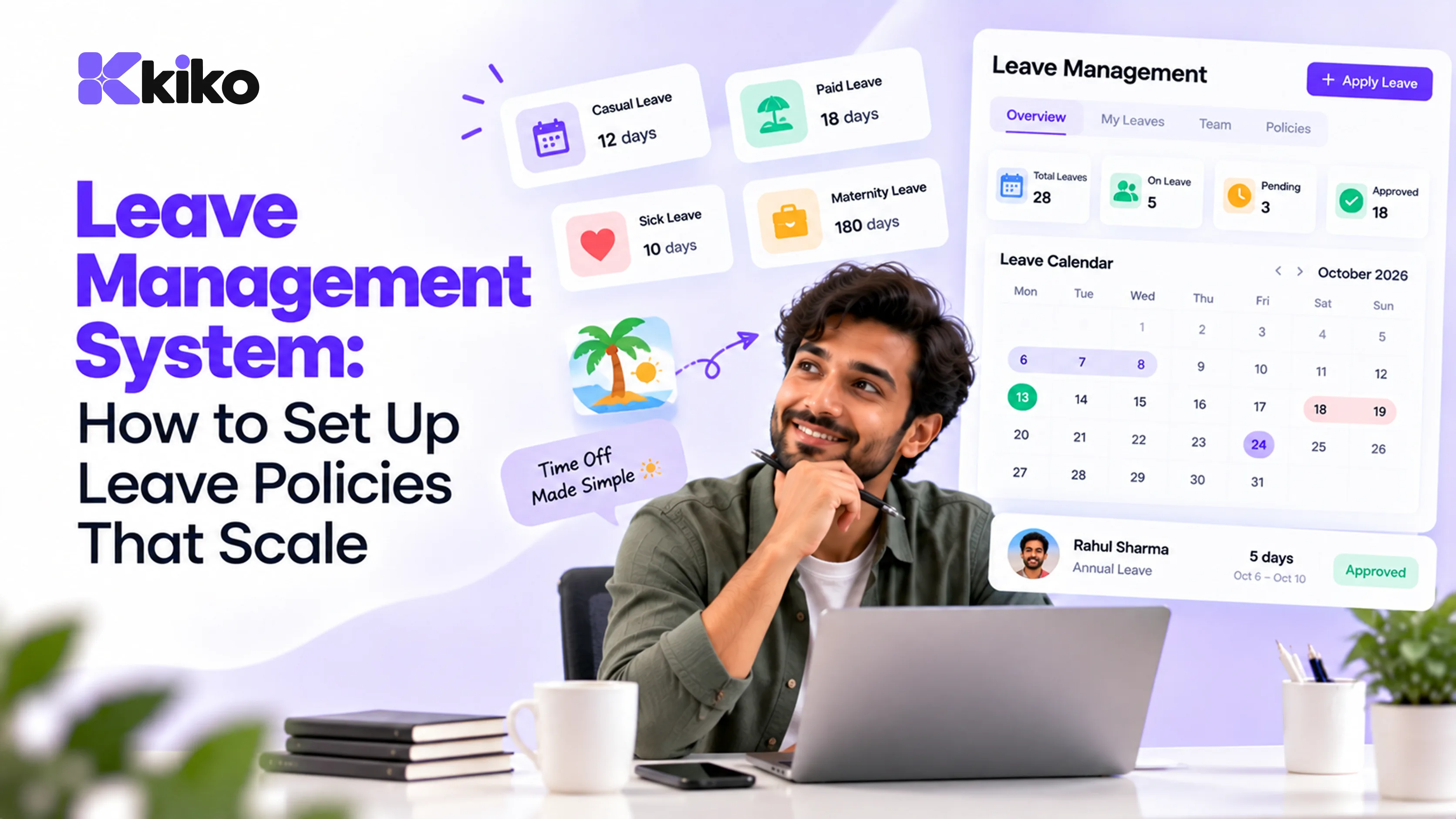
A leave management system lets employees request leave, managers approve it and HR track balances automatically. To set one up, define your leave types, accrual and carry-forward rules, approval workflow and holiday calendar. Then connect leave to attendance and payroll so unpaid leave is deducted correctly without manual work.
Spreadsheets and email work for leave in a team of ten. Beyond that, balances drift and approvals get lost. This guide shows how to design leave policies that scale, with an India-specific table of leave types and a policy template.
What does a leave management system do?
A leave management system replaces the email thread, the shared calendar and the balance spreadsheet with one workflow. At a minimum it should:
- Let employees see their balances and apply for leave from a phone or browser
- Route each request to the right approver and record the decision
- Credit, deduct and carry forward balances according to your rules
- Apply your holiday calendar, including different holidays for different locations
- Show managers a team calendar so they can spot clashes before approving
- Pass approved leave and loss-of-pay days to attendance and payroll
What are the common types of leave in India?
Leave rules in India come from several laws. Most offices and shops are covered by their state's Shops and Establishments Act, factories by the Factories Act, 1948, and maternity leave by the Maternity Benefit Act, 1961. Minimum entitlements therefore vary by state and by type of establishment, and your company policy can always be more generous than the law. India's labour codes also revise several of these provisions, so confirm which rules apply to you today before finalising a policy.
| Leave type | What it is for | Legal basis and notes |
|---|---|---|
| Earned or privilege leave (EL/PL) | Planned time off, usually accrued over the year | Minimums set by state Shops and Establishments Acts. Under the Factories Act, an adult worker who works 240 days or more in a calendar year earns 1 day for every 20 days worked. |
| Casual leave (CL) | Short, unplanned personal needs | Required in many states; the number of days varies by state |
| Sick leave (SL) | Illness or medical appointments | Required in many states; the number of days varies by state |
| Maternity leave | Pregnancy, childbirth and recovery | Up to 26 weeks of paid leave under the Maternity Benefit Act for eligible employees, with a shorter entitlement from the third child onward |
| Paternity leave | Supporting a partner after birth or adoption | Generally set by company policy for private employers |
| Public and festival holidays | National and regional holidays | Republic Day, Independence Day and Gandhi Jayanti are observed nationally; the list of festival holidays varies by state |
| Compensatory off | Time off in return for working on a holiday or weekly off | Company policy, subject to state rules on holiday work |
| Loss of pay (LOP) | Absence with no leave balance left | Unpaid; deducted from salary |
| Other leave (bereavement, marriage, sabbatical) | Specific life events | Company policy |
As a worked example of the Factories Act rule: an adult worker who works 240 days in a calendar year earns 240 ÷ 20 = 12 days of earned leave for the following year.
How do accrual, carry-forward and encashment work?
These three rules decide how balances grow, roll over and turn into money. Write each one down: most leave disputes come from rules that were never stated.
Accrual
Leave can be credited up front (the full year's entitlement on day one of the leave year) or monthly (for example, 1.5 days a month for an 18-day entitlement). Monthly accrual avoids a common problem: an employee taking a full year's leave in the first quarter and then resigning.
For mid-year joiners, use pro-rata credit: annual entitlement × months remaining in the leave year ÷ 12. With an 18-day entitlement and an April to March leave year, someone joining on 1 October gets 18 × 6 ÷ 12 = 9 days.
Carry-forward
Decide which leave types roll over to the next year and up to what limit. A common pattern is to carry forward earned leave up to a cap, while casual and sick leave lapse at year end. Check your state's rules, because some Acts set minimum carry-forward rights.
Encashment
Leave encashment means paying an employee for unused leave instead of letting it lapse, usually earned leave only. Many companies calculate it as (basic + DA) ÷ 26 × days encashed, while others divide by 30. Your policy should state which divisor you use, whether encashment happens yearly above a cap or only on exit, and the maximum days that can be encashed.
| Rule | Option A | Option B | What to consider |
|---|---|---|---|
| Accrual | Full credit at start of year | Monthly credit | Monthly accrual reduces negative balances on exit |
| Carry-forward | Earned leave carries over up to a cap | All leave lapses at year end | State law may set minimum carry-forward rights |
| Encashment | Only on exit | Yearly, above a balance cap | Unused leave is a financial liability; yearly encashment keeps it smaller |
Encashment has tax effects. Encashment while in service is generally taxed as salary, while encashment on retirement or resignation may be partly exempt up to a limit. Check the current limits with your tax adviser.
How should you design the leave approval workflow?
A good workflow is fast for routine requests and careful for long ones. Decide each of these points and write them into your policy:
- Approvers. The direct manager approves most leave. Add a second approver, such as a department head, only for long absences, for example more than five consecutive working days.
- Notice periods. For example, earned leave applied for at least one week ahead; casual and sick leave can be applied for on the day or after.
- Delegation and escalation. When the approver is on leave, requests go to a named delegate. Requests left pending for more than two working days are escalated.
- Blackout periods. If you have peak periods, such as quarter-end or a production season, state them in advance rather than rejecting leave case by case.
- The sandwich rule. Decide whether weekends and holidays that fall between leave days count as leave. Either answer is fine; leaving it unstated is not.
- Half days and documentation. Allow half-day leave if it suits your work, and state when a medical certificate is needed, for example for sick leave longer than two days.
How does leave connect to attendance and payroll?
Leave, attendance and payroll describe the same thing from three sides: whether someone was working on a given day, and whether they should be paid for it. When they live in separate tools, someone has to reconcile them every month.
When they are connected, the flow looks like this:
- An approved leave request marks those days as leave in attendance, not as absent.
- Days with no attendance and no approved leave are flagged for HR review before payroll runs.
- Confirmed unpaid days flow to payroll as loss of pay.
- Leave approved after the payroll cut-off is adjusted in the next month's run.
A typical loss-of-pay calculation is monthly gross ÷ divisor × LOP days. With a monthly gross of ₹30,000, a divisor of 30 and 2 LOP days, the deduction is ₹30,000 ÷ 30 × 2 = ₹2,000. Some companies use the number of calendar days in the month or 26 working days as the divisor instead; state yours in the policy. For the full set of deductions, see our guide to how to calculate payroll in India.
In Kiko HRMS, leave, attendance and payroll share one data layer, so payroll runs use attendance and leave data directly. Employees check balances and apply through employee self-service, and HR can set up and adjust leave balances by leave type.
Leave policy template
Use this template as the outline of your written leave policy. The example column shows one possible choice for each point, not a recommendation or a legal minimum.
| Policy section | What to decide | Example |
|---|---|---|
| Scope | Who the policy covers | All permanent employees; separate rules for contract staff |
| Leave year | Calendar year or financial year | April to March |
| Leave types and entitlements | Days per type, checked against your state's law | Earned 18, casual 8, sick 8 days |
| Accrual | Up front or monthly; pro-rata for joiners | Earned leave accrues monthly |
| Carry-forward | Which types roll over and the cap | Earned leave up to 30 days; others lapse |
| Encashment | When, which types, formula and cap | On exit only, (basic + DA) ÷ 26 per day |
| Applying and approval | Notice periods, approvers, escalation | One week's notice for earned leave; manager approves |
| Holidays | Holiday list per location | Published each December for the next year |
| Sandwich rule | Whether weekends between leave days count | Not counted |
| Loss of pay | When LOP applies and how it is calculated | Monthly gross ÷ 30 × LOP days |
| Statutory leave | Maternity and any other legally required leave | As per the Maternity Benefit Act and state law |
Frequently asked questions
How many days of leave are employees entitled to in India?
There is no single national number. Entitlements depend on your state's Shops and Establishments Act, whether the Factories Act applies, and your company policy. For example, the Factories Act gives adult workers 1 day of earned leave per 20 days worked after 240 days in a year, and the Maternity Benefit Act allows up to 26 weeks of maternity leave. Confirm the rules for your state.
What is leave encashment?
Leave encashment is a payment for unused leave, usually earned leave, either each year above a set balance or when an employee leaves. It is commonly calculated as (basic + DA) ÷ 26 or ÷ 30, multiplied by the days encashed. Your policy should state the formula, the cap and when it applies.
Can unused leave be carried forward?
Yes, if your policy allows it, and some state laws require earned leave to be carried forward up to a limit. Most companies let earned leave roll over up to a cap and let casual and sick leave lapse at year end. Check your state's minimum before setting a lower cap.
How do I track leave for shift workers?
Count leave in shifts or hours rather than calendar days, and base it on each worker's own roster, so a rotating weekly off is never counted as leave. Decide how holidays that fall on a scheduled shift are handled, for example with a compensatory off. Connecting the shift roster to attendance makes this automatic.
Set up leave policies in Kiko HRMS
Define leave types, accrual and approvals once, and let balances, attendance and payroll stay in step. See how it works for HR teams, or book a demo to set up your leave policies in Kiko HRMS.